What is wood joining by high-frequency heating?
Devices for wood gluing using dielectric heating have been in practical use since around the 1950s, and these devices are widely used to produce furniture, structural engineered materials (laminated lumber/laminated veneer lumber/CLT/PB), doors, wall plates, floor materials, and wooden boxes in Japan. Although microwaves of 2,450 or 915 MHz are sometimes used, high-frequency waves of 3 to 30 MHz are used in most cases.
Dielectric heating of wood
Heating using vapor, hot plates, or hot air is based on thermal conduction from the outside, and the heating rate is controlled by the thermal conductivity. In this case, an object is heated from its outside to inside. On the other hand, dielectric heating methods using high-frequency waves and microwaves are able to heat both the inside and outside of an object consistently in seconds. The dielectric loss factor of wood is larger and it generates heat more easily compared to other materials, such as plastics, ceramics, and rubber. Furthermore, dielectric heating allows for more efficient wood gluing, since the coefficient loss of adhesive resin used for wood gluing, as presented in the following table, is higher than that of dried wood.
Method of heating
Representative high-frequency dielectric heating methods to adhere wood and wood materials to each other are presented here.
1. Overall heating
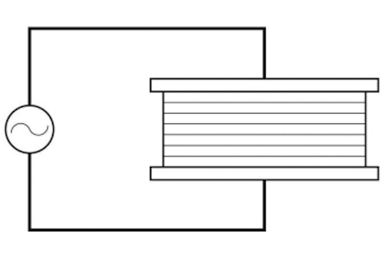
Figure 1. Overall heating
A whole object positioned between a pair of electrodes is heated consistently. As the loss coefficient of glue is higher than that of wood, it generates heat more promptly and efficiently than wood. This heating system is used for plywood, curved and laminated wood, and LVL (Figure 1).
2. Selective heating
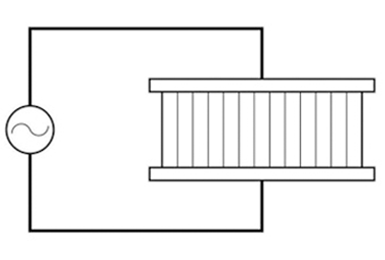
Figure 2. Selective heating
Pairs of flat-plate electrodes arranged parallel to each other and in the opposite direction are vertical to the wood (single and sawn boards) and its gluing layer. Equipment using this system is able to solely heat the gluing layer more efficiently, rather than the overall area of the wood, by converging high-frequency electric fields on the layer. This is a representative gluing method also referred to as “glue line heating”, which is widely used to adhere pieces of laminated wood to each other or other objects, and to attach the sides of wood plates for furniture to each other (Figure 2).
3. Partial heating
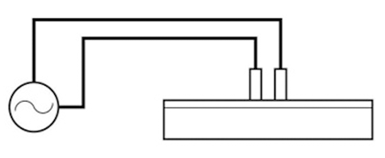
Figure 3. Partial heating
In this partial heating system, combinations of different forms and sizes of electrodes are used to converge high-frequency electric fields on specific areas that need to be heated. The partial heating system is used to assemble boxes and frames, as well as temporarily spot adhesion of veneers (Figure 3).
4. Surface heating
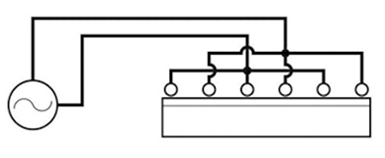
Figure 4. Surface heating
Conductor bars, called grid electrodes are arranged in a reticular pattern on the surface of objects to be heated, generating strong electric fields between pairs of grid electrodes and efficiently heating the surface and superficial layer of objects. These grid electrodes are used to adhere the wood surfaces of frames of furniture, such as doors, to other objects (Figure 4).
Related News
- DANH SÁCH MỘT SỐ CÔNG TY CHẾ BIẾN GỖ NỘI THẤT CÓ UY TÍN TẠI VIỆT NAM
- (Tiếng Việt) Triển vọng ngành chế biến gỗ năm 2024
- (Tiếng Việt) Sửa chữa máy ghép cao tần khắp cả nước
- (Tiếng Việt) Công dụng và Ứng dụng của BIẾN ÁP
- (Tiếng Việt) Khó khăn của ngành sản xuất đồ gỗ.
- (Tiếng Việt) Các dòng biến áp và dịch vụ sửa chữa máy ghép gỗ cao tần
- Low frequency Transformers
- Low frequency transformer working characteristics
- High frequency coil structure
- Frequency transformer prediction
